
AI Merge · Free Parenting Belief Score
Parents of teens: worried you’re losing the closeness you used to have?
Take the free 5-question Parenting Belief Score to uncover a hidden belief that may be shaping how you respond in the very moments you most want your teen to open up.
This video uses an AI-generated avatar and voice of Manuj Aggarwal.
Free · About 10 minutes · No credit card · Looks at you, not your child · No diagnosis
Built on AI Merge, a methodology published in the Mensa Research Journal.
I · If any of this sounds familiar
It never happens in one conversation.It happens in a hundred ordinary ones.
Parents of teenagers describe it in different words. Usually it sounds like one of these.
“We used to talk about everything.”
“Now I feel like I’m walking on eggshells.”
“I give them space, but they seem even farther away.”
“I try to help, and somehow it turns into an argument.”
“I don’t understand why the same conversations keep going wrong.”
These are things parents say, not symptoms to check off. None of them is a sign that something is wrong with your teenager.

At six, you knew everything about their day.
At sixteen, you get three words and a closed door.
Nobody tells you which year it changes. It just does - one ordinary exchange at a time, until the distance is simply how things are.
Age 8
Tells you everything.
Age 13
The door starts closing.
Age 17
Fine. Nothing. Later.
Age 22
You hear it from someone else.
A pattern most parents recognise - not a prediction, and not a measurement of your child.
By the time it is obvious, the pattern that built it is years old.
Free · About 10 minutes · No credit card · Looks at you, not your child · No diagnosis
II · The perception gap
You were both in the same conversation.You did not both have the same experience of it.
This is not a failure of love or attention. It is the part of a relationship neither side can see from where they are standing.
Parents
76.9%
said their teenager always gets the social and emotional support they need.
Teenagers
27.5%
said they always get the social and emotional support they need.
49.4 points between what parents reportand what teenagers report.
Asked how often their own teenager gets the social and emotional support they need, 76.9% of parents answered “always”. Asked the same question about themselves, 27.5% of teenagers did.
That does not mean most parents are wrong about their own child, and it cannot tell you anything about yours. Some of the distance is in how the two groups were surveyed. But the part that is not is worth sitting with: the read a parent has of the relationship and the experience a teenager is having of it can sit a long way apart - quietly, and without anyone doing a thing wrong.
A gap you cannot see is a gap you cannot close.
Free · About 10 minutes · No credit card · Looks at you, not your child · No diagnosis
III · What the score is
You cannot rewind their teenage years.You can change what happens next time you speak.
So the Parenting Belief Score asks five personalised questions about one real interaction, and helps surface a belief that may be influencing how you respond to it.
It examines you, not your teenager.
“But the situation with my teenager is real.”That may be true.
“I’m not trying to control anything. I just want to stay close.”That may be true.
- Stage 1Concern rises
Something matters, and not knowing starts to feel risky.
- Stage 2You step in
Another reminder. Another question. The responsible thing.
- Stage 3Nothing to compare
Stepping in hides what would have happened if you hadn't.
and the concern returns
This is not about caring less. It is about the same care costing you - and them - less.
Free · About 10 minutes · No credit card · Looks at you, not your child · No diagnosis
IV · How it works
Three steps,about ten minutes.
- 1Describe one real momentTell us about an interaction with your teenager, in your own words. One moment, not your whole relationship.
- 2Answer 5 personalised questionsBuilt from what you just described, to explore what may be happening underneath your immediate response.
- 3Receive your Parenting Belief ScoreSee the belief or pattern your answers surface, and how it may relate to the interaction you described.
What it is
- Personalised to the one moment you describe
- Built from your own words, not a questionnaire
- Focused on your side of the interaction
What it is not
- Not an assessment of your teenager
- Not a diagnosis, and not therapy
- Not a parenting course
- Not a verdict on whether you are a good parent
Free · About 10 minutes · No credit card · Looks at you, not your child · No diagnosis
V · Your score
One number for the thingyou cannot see yourself.
Describe one real moment with your teenager in your own words. Your score places how much of that moment you are actually choosing.
41
out of 100
Illustrative
Most people start near 48
Under 36
The moment is deciding for you
The response arrives before you have chosen it. Something you haven’t named yet is doing the deciding - so the same conversation keeps repeating. This is where the most room to move sits.
76 and above
You are deciding
You can say what you actually want, respond like the parent you know you are, and let the moment end without needing to go round it again.
The four things your score reads
- 78
Direction Clarity
How clearly you can say what you actually want in this moment, in your own words.
- 66
Identity Alignment
How closely the way you respond matches the parent you feel you are.
- 74
Decision Readiness
How ready you are to make the call instead of going round the same loop again.
- 42
Energy Alignment
How much of your energy this pattern is quietly using up.
Free · About 10 minutes · No credit card · Looks at you, not your child · No diagnosis
VI · What arrives
Your score is on screenbefore you close the tab.
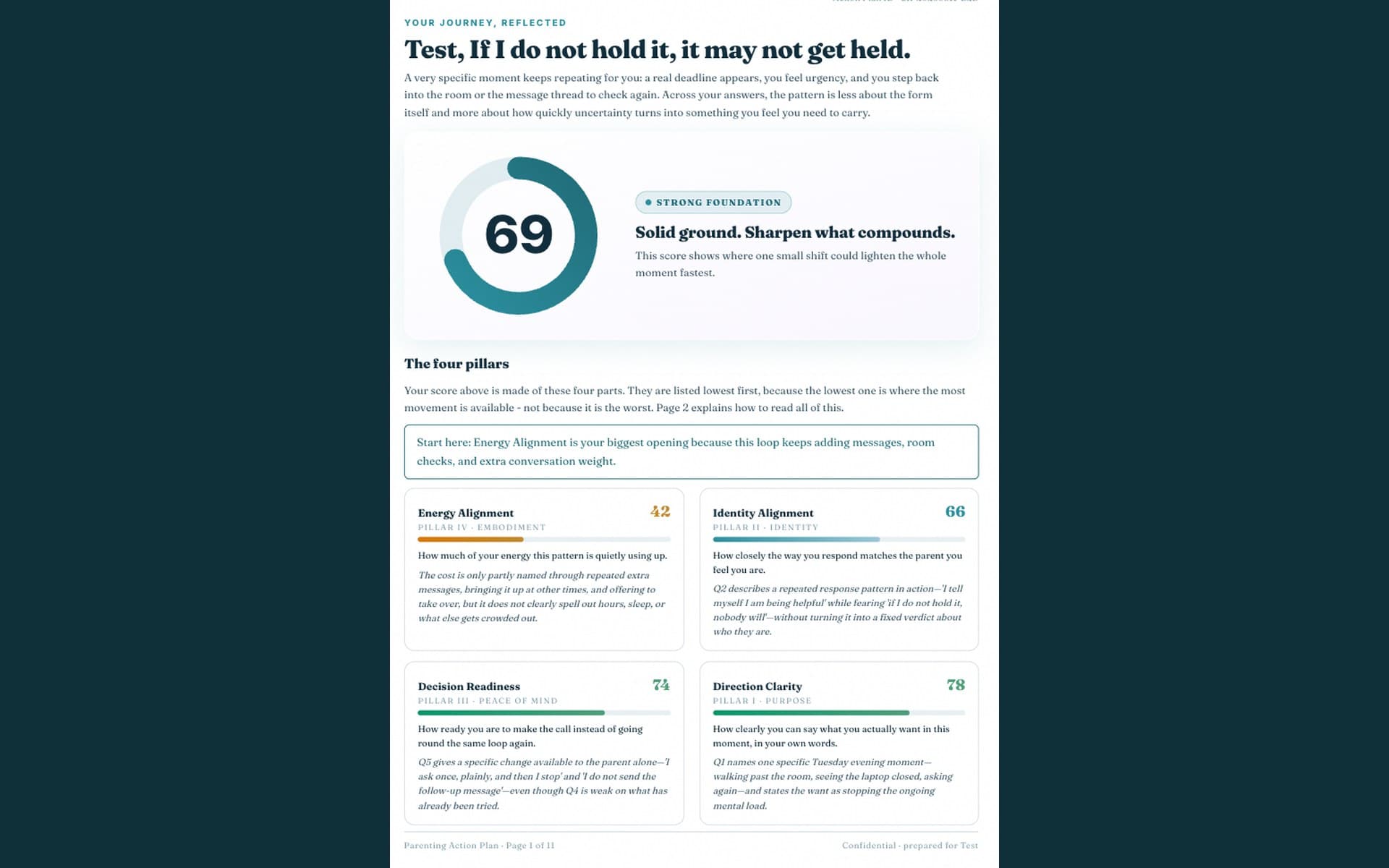
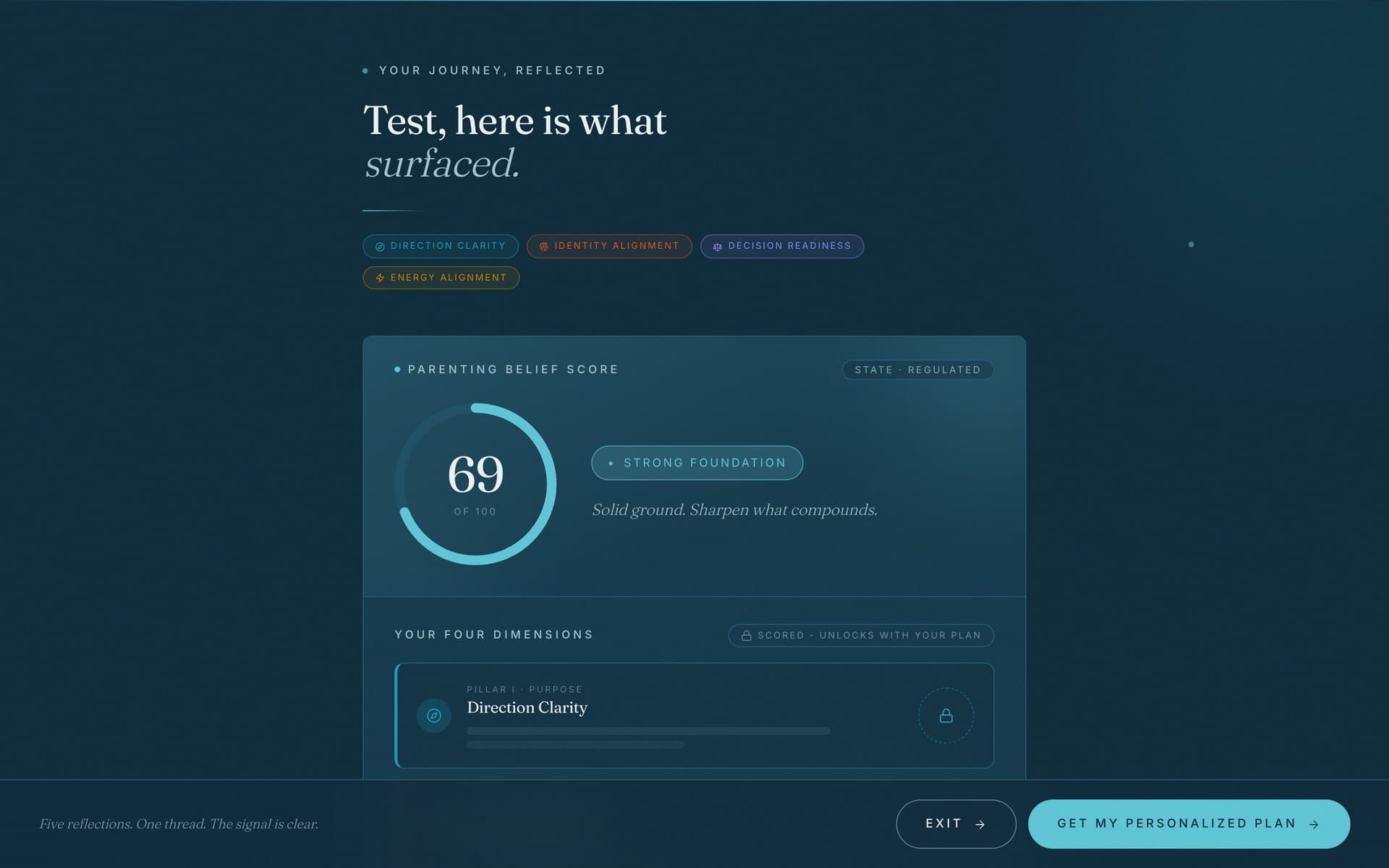
- Free · on screen in about 10 minutesYour Parenting Belief ScoreYour number out of 100, the four dimensions behind it, and the moment your own answers keep circling back to.
- Optional · after your scoreThe full written breakdownThe complete document: the possible belief your words point to, where the loop begins, and the point where you may have more choice than it feels like.
- Optional · when you want to go furtherThe AI Merge programThe guided path for parents who would rather work a pattern than read about one.
Your Parenting Belief Score is free and complete on its own. You are never required to buy anything to receive it.
Free · About 10 minutes · No credit card · Looks at you, not your child · No diagnosis
VII · The walkthrough
See the whole thingbefore you begin.
Five questions. One moment. Your score - start to finish, before you commit to anything.
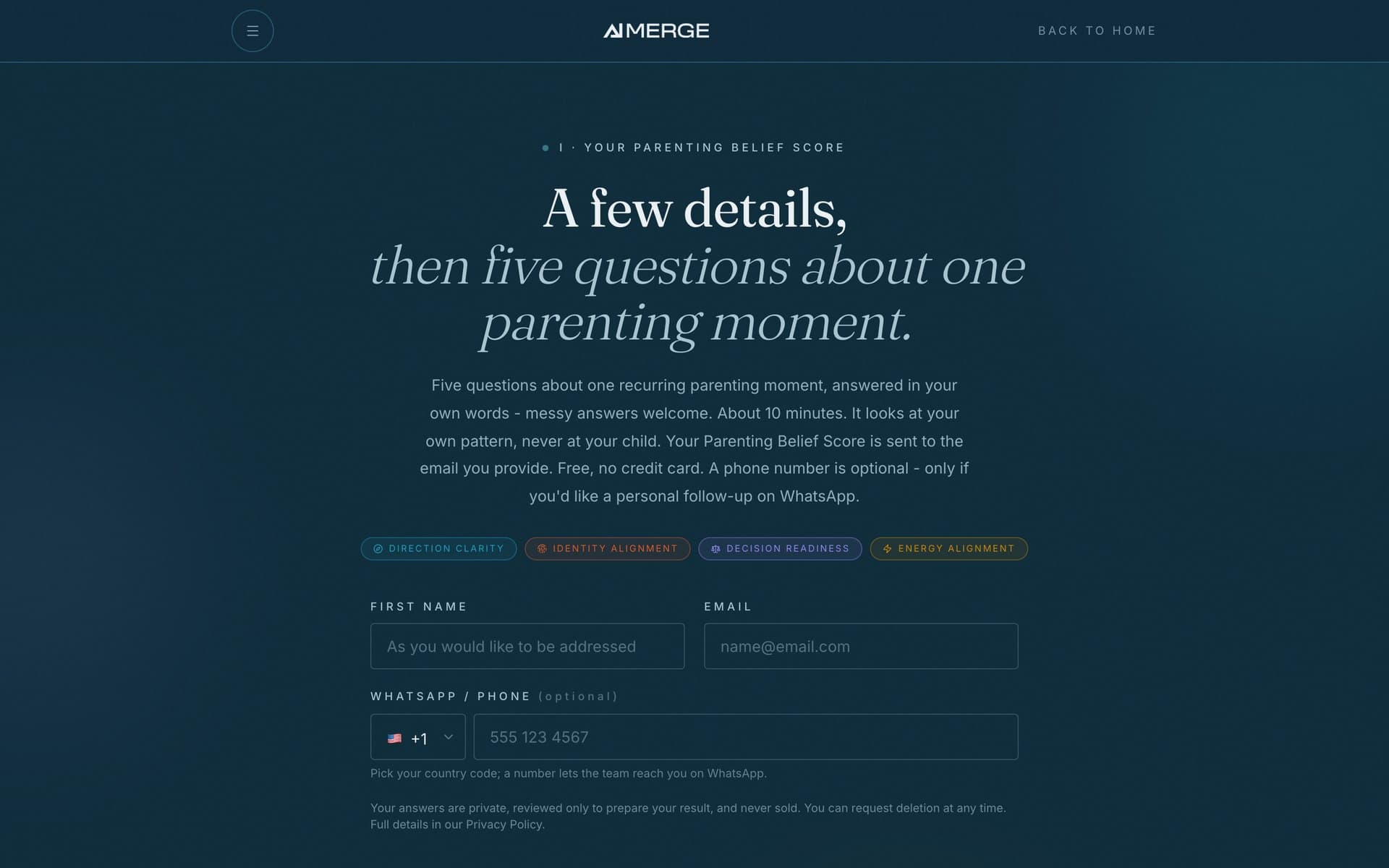
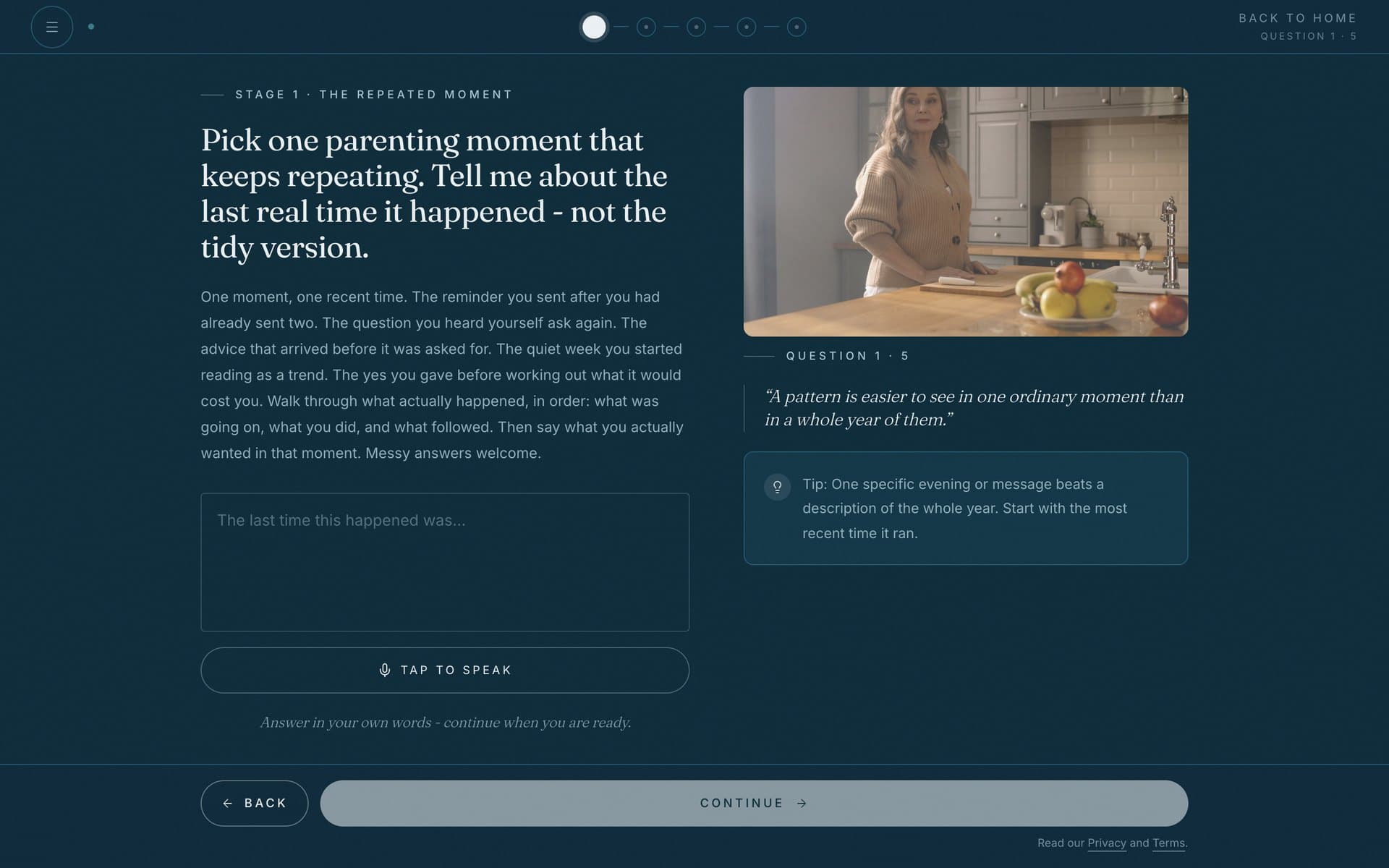
Your name and the email your result is sent to. A phone number is optional. Your answers are private, and the score is yours to keep. Free, with no credit card.
VIII · Who built it
I could see the moment.I could not see what was driving it.

Understanding the situation didn’t automatically reveal what was shaping my response. That gap is why I built the Parenting Belief Score - using AI Merge, a methodology I created and published in the Mensa Research Journal.
AI Merge is a personalised methodology for examining the relationship between what a person believes, how they interpret a moment, and how they respond to it. Changes have been documented among participants in the broader AI Merge work.
The result isn’t meant to replace your judgment. It’s meant to give you something clear enough to examine.
Manuj Aggarwal
- Founder & CIOTetraNoodle Technologies
- Four patentsGranted
- Mensa Research JournalPublished methodology
- AI MergeCreator of the method
“There's a stress part of my brain that has gone silent.”
Nick H.· Video Producer “It shifted something within. It's something I'm going to be reading over and over again.”
Oliver· Real Estate
Individual experiences vary. These accounts reflect experiences across the broader AI Merge work rather than the free Parenting Belief Score, and do not guarantee that another participant will receive the same result.
Prior professional work





Organizations shown reflect prior professional work by Manuj Aggarwal and do not imply endorsement of the Parenting Belief Score, AI Merge, TetraNoodle Technologies, or this offer.
Free · About 10 minutes · No credit card · Looks at you, not your child · No diagnosis
IX · Questions
Questionsparents ask.
- Is this evaluating my child?No. It looks at you, and at the interaction you describe in your own words.
- Is this a diagnosis?No. It is not a medical or psychological diagnosis, and it is not treatment.
- Does my teenager have to take part?No. Your teenager never needs to participate, and never needs to know.
- Is this another parenting course?No. It is a short personalised assessment of one real interaction.
- Will I be judged?No. The goal is curiosity and reflection, not a grade on your parenting.
Is this about me or my child?
It's about your own pattern as a parent - your interpretation, meaning, response, and recurring loop in one parenting moment.
The Parenting Belief Score does not assess, score, or diagnose your child, and it won't tell you what they think, feel, intend, or are capable of.
Is this a diagnosis or a professional service?
No. The Parenting Belief Score is an educational and reflective tool - not diagnosis, treatment, or medical, psychological, legal, or family-therapy services.
Parenting is shaped by development, circumstances, personality, health, finances, history and culture. The score examines one possible layer: what may be shaping your own response.
Is the Parenting Belief Score really free?
Yes. You receive your personalised Parenting Belief Score free, with no credit card required.
Afterward, you may be offered an optional detailed breakdown and personalised Action Plan. You're never required to buy anything to get your score.
What happens with the information I provide?
[INSERT APPROVED PRIVACY, STORAGE, HUMAN-REVIEW AND MODEL-TRAINING WORDING]
Will this tell me how to make my child change?
No. The Parenting Belief Score doesn't promise more contact, improved performance, greater independence, or different decisions.
It focuses on the part of the moment available to you.
What if the result feels inaccurate?
Treat it as a hypothesis, not a verdict. Accept part of it, reject it, or refine it.
Technology helps organise what you provide and suggest a possible pattern - it cannot read your mind, it doesn't know your child, and it doesn't decide what's true. You decide what fits.
How does this fit with support I'm already getting?
Keep what helps. Parenting education offers practical strategies. Therapy helps with emotional, relational and clinical concerns. A counselor, physician, financial adviser or school professional helps with circumstances needing their expertise.
The Parenting Belief Score examines a different layer - the meaning and response forming inside your own moment. It can help you enter those conversations clearer about what may be yours, and what may not be.
Free · About 10 minutes · No credit card · Looks at you, not your child · No diagnosis

A closing
The next conversation is coming. You decide who shows up to it.
If you miss feeling close to your teenager, start by examining what is happening on your side of the interaction.
5 questions · About 10 minutes · Free · No credit card · Your teen never needs to participate
Your result is a personalised hypothesis. You decide what fits.